
Written by: Madison Olmsted
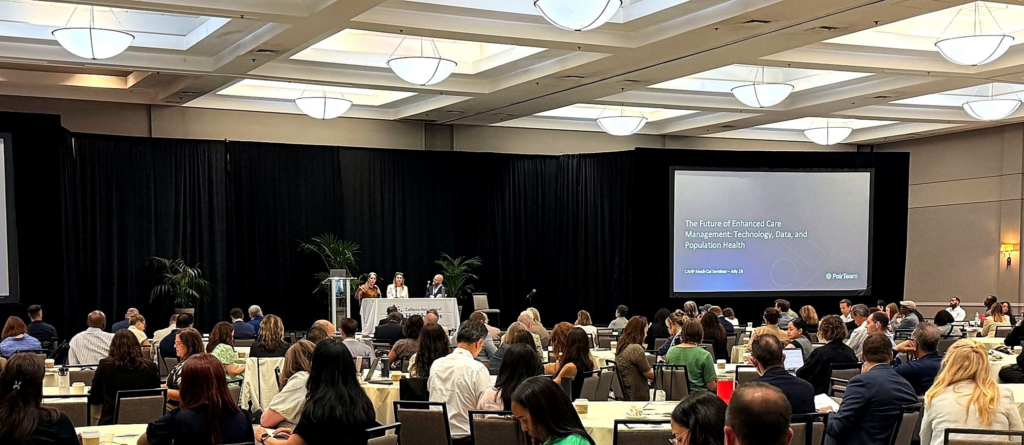
At the California Association of Health Plans (CAHP) Seminar on July 28, 2026, the panel “The Future of Enhanced Care Management: Technology, Data, and Population Health” brought together Jacey Cooper (Precision Health Strategies) and Timi Leslie (BluePath Health), moderated by Nate Favini (Pair Team), for a discussion on where CalAIM and Enhanced Care Management (ECM) stand five years into California’s waiver program. The panelists also discussed what AI can realistically do for patient engagement today and what it would take to give every Medi-Cal member proactive support.
The clearest theme of the discussion was that CalAIM has moved faster than any prior Medi-Cal reform because the state funded infrastructure directly, not just services. That investment paid off by creating an entirely new muscle of relationships across counties, community-based organizations (CBOs), health plans, and correctional facilities that didn’t formally exist before, built and tested through structures like the PATH Collaborative and Planning Implementation (CPI) Collaboratives.
Jacey Cooper emphasized that the populations of focus identified by the Department of Health Care Services (DHCS) for ECM were the right ones, and California must protect the benefit going forward. These same populations of focus are likely to be negatively impacted by the implementation of H.R. 1 and other Medi-Cal eligibility changes, and it would be detrimental to not lean on the CalAIM CBO network specifically to protect members’ access to coverage.
Alongside that progress, the panel was direct about where CalAIM implementation still needs work. Progress has moved noticeably faster on the CBO side than on the hospital side, and members transitioning out of high-intensity clinical settings have not received ECM at the same rate as other populations of focus. Additionally, payment structure was discussed as a related challenge: panelists discussed the need for ECM payment to be right-sized to the intensity of the population being served and to the value delivered, rather than at a flat rate.
These threads, while protecting and extending the relationships CalAIM has built while being honest about where the model needs to evolve, also provided a forward-looking case for the safe adoption of AI Advocates as one strategy for sustaining the infrastructure investment that California has already made. As the next year brings additional Medi-Cal enrollment changes, building upon and improving what is already working will be more critical than ever.
To learn more about the potential for AI Advocates in Medi-Cal, check out the AI-Powered Advocates for Medi-Cal Bold Idea.